
Poverty takes a toll on health across the EU
Eurostat figures show that people at risk of poverty are significantly more likely to experience health-related difficulties
People at risk of poverty across the European Union face significantly greater health difficulties in everyday life, new Eurostat figures reveal, exposing persistent inequalities between income groups.
In 2025, almost one in four people at risk of poverty (24.9%) reported moderate or severe difficulties walking, compared with 16.9% of those not at risk.
The divide extends across other essential activities. Difficulties remembering or concentrating affected 20.6% of people at risk of poverty, against 14.5% of others, while problems seeing were reported by 23.8% and 18.9% respectively.
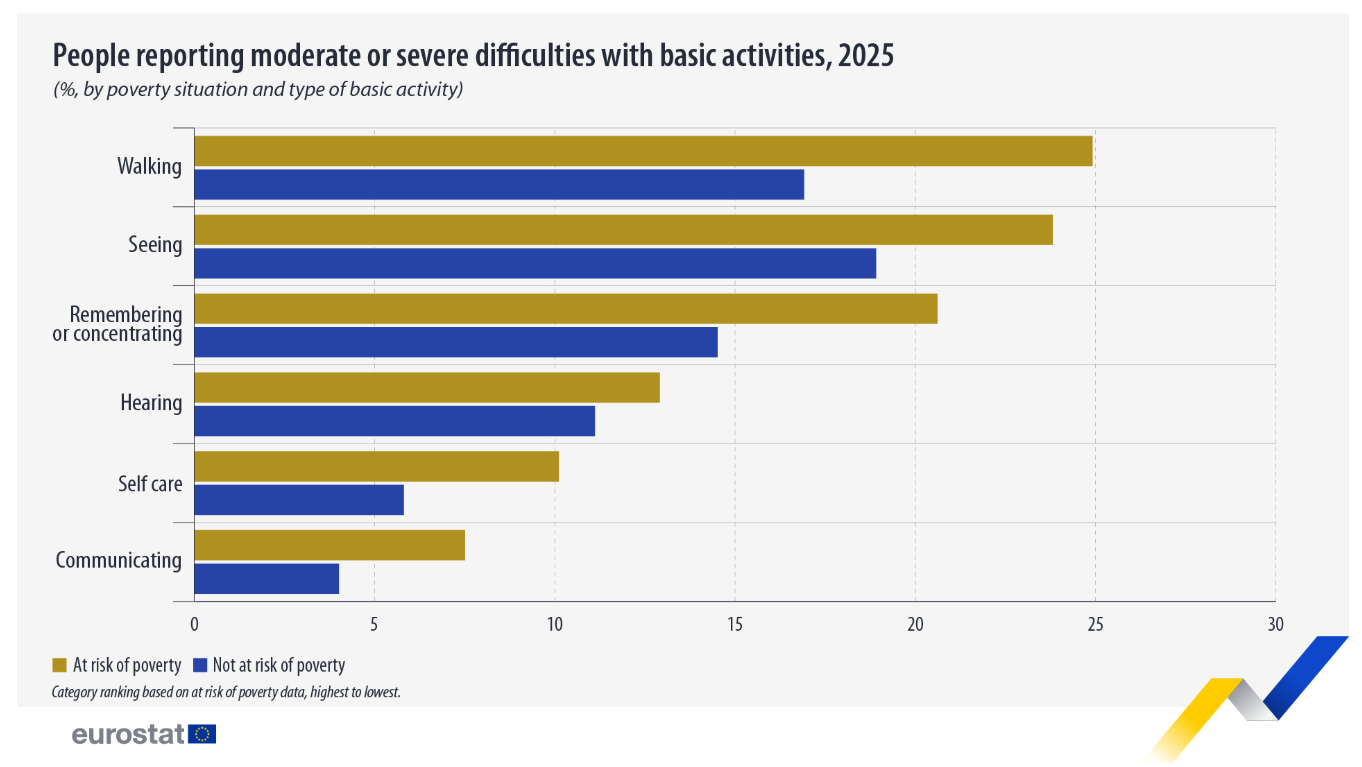
The disparities were particularly stark for self-care, with 10.1% of those at risk reporting difficulties, nearly double the 5.8% among those not at risk. Communication difficulties affected 7.5% versus 4.0%, while the gap was narrowest for hearing difficulties, at 12.9% compared with 11.1%.
The findings come as 92.7 million EU residents, or 20.9% of the population, faced poverty or social exclusion in 2025, down only marginally from 93.3 million in 2024.
Earlier this year, EuroHealthNet a not-for-profit partnership of organisations, institutes, and authorities working on public health underlined the importance of the EU addressing poverty.
“Poor health and poverty are interlinked. We cannot hope to end one without addressing the other. Health is rooted in the security of a warm home, financial stability, and a fair start in life,” said EuroHealthNet director Caroline Costongs.
The organisation called for health to become a central pillar of the EU’s forthcoming Anti-Poverty Strategy, backed by dedicated funding and stronger social investment.
Eurostat defines people at risk of poverty as those earning less than 60% of their national median disposable income after social transfers.
The figures reinforce the case for treating poverty not simply as an income problem, but as a major challenge for public health and social equality across Europe.