
EU weighs age-13 limit for 'social media plus'
An expert panel has urged the EU to make technology companies prove their platforms are safe before allowing under-13s access to "social media plus" services

The European Commission will consider proposing an EU-wide restriction on access to "social media plus" services for children under 13, following recommendations from an expert panel whose findings will inform legislative proposals expected this autumn.
The panel argues that technology companies, rather than parents, regulators or children, should have to demonstrate that their services are safe before they can be made available to younger users. It recommends restricting access for under-13s across the EU, while allowing member states to introduce higher age limits for older teenagers if they choose.
European Commission President Ursula von der Leyen said the executive would carefully read it, discuss it in the College, and make a proposal after the summer. She said that she found the panel's phased approach "very convincing".
“Just as we do not give our children keys to the car before they have their licence or let them buy alcohol until they are legally allowed, we need to set the age at which they can legally access social media,” von der Leyen.
Under that model, children under 13 would only use social media under the supervision of parents, caregivers or teachers, while access for older teenagers would depend on platforms proving their services are age-appropriate and safe.
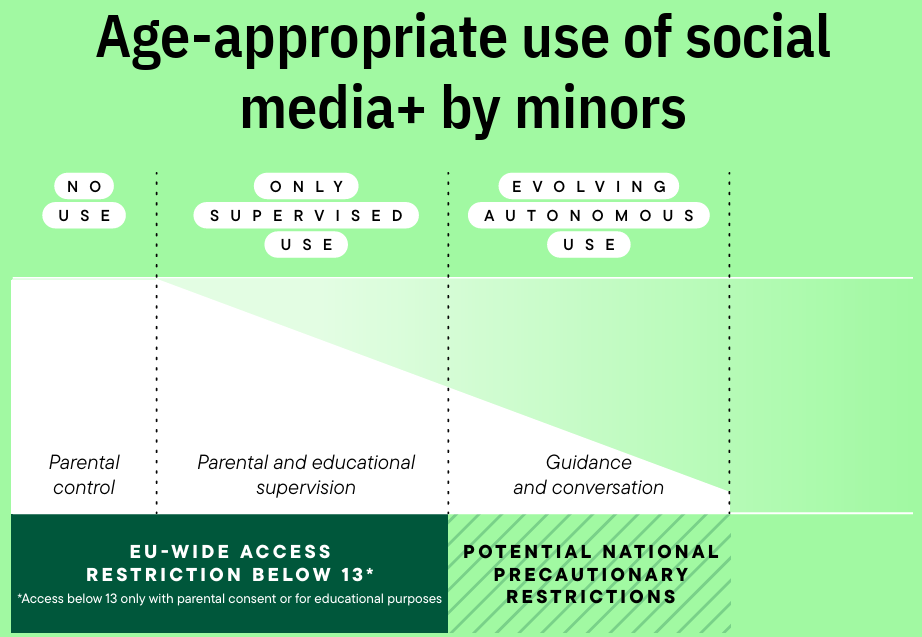
‘Social media plus’
The recommendations go further than traditional social media platforms. The report uses the term "social media plus" to cover a broader category of digital services that includes: AI companions, video games that expose children to harmful commercial practices or dangerous contacts, and video-sharing platforms that allow children to access age-inappropriate content.
Dr Maria Melchior, who co-chaired the expert panel, said any new rules should combine age verification with privacy protections and stronger digital literacy: "Security-by-design needs to be linked to age verification measures, which are effective but which respect users' privacy as well," adding that parents also need better tools to supervise children's use of digital services.
Co-chair, Professor Jörg Fegert, said the responsibility should rest with providers. "It's the social media plus providers who have to demonstrate that their content is age-appropriate and safe," he said, arguing for stronger oversight and complaints mechanisms to ensure children's concerns are dealt with effectively.
Digital Services Act
The proposals would sit alongside, rather than replace, the obligations already imposed on online platforms under the Digital Services Act (DSA). The Commission argues that while the DSA requires platforms to tackle systemic risks and harmful design, additional safeguards may be needed for children.
Von der Leyen pointed to recent enforcement action under the DSA, including the Commission's preliminary findings against Meta announced on Friday. She said the legislation already requires providers to remove addictive features, dark patterns and harmful content, but indicated that further measures may now be necessary to better protect children online.
The Commission's investigation found that Meta may have breached the DSA by failing to properly assess the risks posed by the design of Facebook and Instagram, particularly for minors and vulnerable adults.
According to the Commission, Meta did not adequately consider how features including highly personalised recommendations, autoplay and infinite scroll encourage prolonged use by constantly presenting users with new content. Investigators said those features can push users into an "autopilot mode", contributing to unhealthy habits and compulsive use.
The Commission also said Meta failed to take sufficient account of evidence on how much time minors spend on Instagram and Facebook during the night, or how features such as Reels and Stories could encourage excessive engagement.
The Commission said that mitigation measures introduced on Instagram and Facebook, including those enabled by default for teenagers, can be easily dismissed and do not significantly reduce usage. It also argued that parental controls are effective only if parents have the technical knowledge and time to configure and monitor them, limiting their ability to address the underlying risks created by the platforms' design.
If those preliminary findings are confirmed, the Commission could issue a formal non-compliance decision against Meta. That could lead to fines of up to 6% of the company's total worldwide annual turnover, depending on the nature, gravity, recurrence and duration of any infringement.