
Commission estimates the cost of Biotech Act protections at €210 million per year
A Commission Staff Working Document supporting the Biotech Act I presented in December shows that the estimated cost of an extension to supplementary protection certificates could exceed €210 million per year

The European Commission has just released a Staff Working Document (SWD) outlining its analysis in support of the Biotech Act I. The publication comes more than five months after the Commission presented its proposal in mid-December.
One of the more contentious proposals in the Act is the proposal to offer an additional one-year Supplementary Protection Certificate (SPC) extension for certain advanced therapies, on the condition that late-stage clinical trials are conducted in more than two EU member states and that at least part of the manufacturing process takes place within the EU.
While the Commission argues that the measure could strengthen Europe’s biotechnology ecosystem, critics warn that it could come at a high cost to public healthcare systems and delay patient access to cheaper biosimilar medicines.
As Europe tries to ensure the competitiveness of its biotech sector - one of few areas where Europe is still highly productive - SPCs may seem like an easy solution that does not require a direct demand on the EU’s cash-strapped national treasuries, however it's a solution that does not come without costs.
According to the Commission SWD the extension is intended to reward “highly innovative biotechnology-based products” delivering significant therapeutic benefits, particularly in areas where treatment options remain limited.
However, the economic assessment also highlights substantial costs. The Commission analysed 198 innovative medicines that lost patent or regulatory protection between 2016 and 2024. Of the 31 biologic medicines identified, 12 relied on SPCs as their final form of market protection. Based on that sample, officials estimate that the proposed extension would affect around two to three medicines annually, though if it is successful as an incentive, it could be even higher.
Extensions are not cost-free. The Commission estimates that each additional year of protection would cost EU public healthcare payers approximately €70 million per medicine. Aggregated across three medicines per year, that amounts to roughly €210 million annually in additional direct costs. The authors sound a note of caution, stressing that the estimates are based on list prices and do not account for discounts or clawback mechanisms, so the actual costs could be lower.
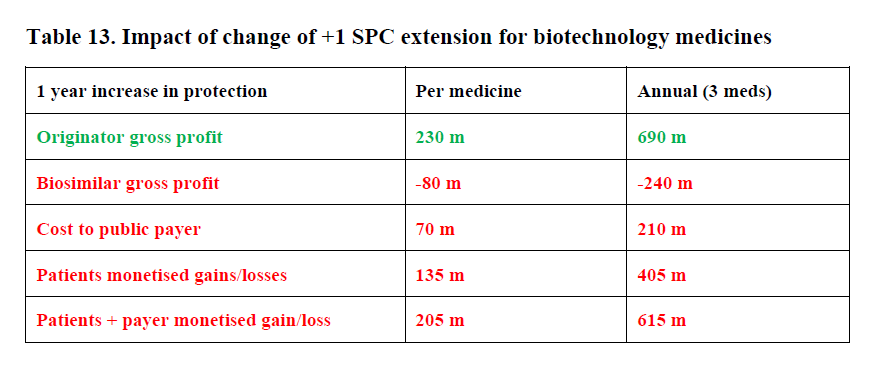
The extension would also postpone biosimilar competition, which normally drives prices down and expands patient access. According to the Commission’s own modelling, delaying biosimilar entry by one year reduces the number of patients treated because lower-cost alternatives arrive later. The report calculates a “patient monetised loss” of approximately €135 million per product, or €405 million annually for three medicines, reflecting the additional spending required to achieve the same level of patient coverage that would exist without the extension.
Medicines for Europe, which represents the generic and biosimilar sector, strongly opposes a measure they say gives company 16.5 years of effective protection and which has not delivered on the objective of attracting investment. The association points to research carried out in a 2020 analysis by the Commission and Technopolis showing the existing SPC had “a limited effect in tackling the objective of attracting R&D to the EU, and found that “the financial benefits fall mostly outside the EU”.
 Catherine Feore
The impact on competition is particularly significant in the biologics sector, where biosimilars already face higher barriers to entry than generic versions of conventional medicines. The Commission acknowledges that the extension would result in “temporary postponement of additional product entry”.
Industry supporters argue that the incentive could nevertheless help shift investment decisions toward Europe. The Commission assesses that if companies altered their behaviour to meet the conditions attached to the scheme, the number of qualifying products could rise from two or three annually to four or five.
The debate surrounding the SPC extension reflects a broader tension at the heart of EU pharmaceutical policy: balancing incentives for innovation against the affordability and accessibility of medicines.
While the Commission views the measure as a strategic investment in Europe’s biotech future, healthcare payers and patient advocates are likely to scrutinise whether the economic benefits justify hundreds of millions of euros in delayed savings and postponed access to lower-cost treatments.