Inside EU Health: First EU joint clinical assessment; Hantavirus; protecting healthcare in conflict zones; disability
First EU joint clinical assessment is a milestone; Hantavirus poses little risk to wider public; international organisations mark failure to protect health care in conflict zones; disabled people face disproportionate discrimination in public services
First EU joint clinical assessment is a milestone
The first Joint Clinical Assessment (JCA) under the EU’s Health Technology Assessment Regulation has been completed for tovorafenib, an oncology medicine used in the treatment of paediatric low-grade glioma.
Ireland’s National Centre for Pharmacoeconomics (NCPE) acted as assessor alongside Germany’s Institute for Quality and Efficiency in Health Care (IQWiG) as co-assessor. The report received approval from the Health Technology Assessment Coordination Group (HTACG) on 30 April 2026.
Roisin Adams, Head of HTA Strategy at NCPE, welcomed the collaboration, saying: “We look forward to continuing this spirit of open and constructive collaboration with other HTA bodies in future joint assessments.”
“We are proud to have been directly involved right from the very first report,” said Head of IQWiG’s Drug Assessment Department Beate Wieseler. “Working together was very valuable; we were able to learn a great deal from one another and, at the same time, demonstrate that the new EU HTA process works.”
“We look forward to the publication of the first report in the coming days and to following its use in national HTA assessments and impact on local access decisions over the next months,” said EUCOPE Secretary General Alexancer Natz.
The assessment report will now be sent to the European Commission for procedural review before being published online.
Hantavirus poses little risk to wider public
The Hantavirus outbreak linked to a cruise ship voyage across the South Atlantic has triggered an international response from the World Health Organisation after passengers developed severe respiratory illness during the journey. WHO has confirmed seven cases, including two laboratory-confirmed infections and three deaths. One critically ill patient remains in intensive care in South Africa.
WHO/Europe Regional Director Hans Kluge said the agency is supporting “medical care, evacuation, investigations and public health risk assessment” and ensuring a “coordinated, science-based response.”
WHO is working closely with authorities in the Netherlands, Cabo Verde, South Africa, Spain and the United Kingdom to coordinate evacuations, testing and public health measures. She added that “contact tracing is ongoing” while investigations continue into the source of infection.
Passengers are advised to monitor symptoms for 45 days. Although there is no specific treatment or vaccine, both Kluge and van Kerkhove stressed that the overall public risk remains low and that no travel restrictions are recommended.
 Catherine Feore
International organisations mark failure to protect health care in conflict zones
Ten years ago, the UN Security Council unanimously adopted Resolution 2286 on health care in armed conflicts. The heads of the International Committee of the Red Cross, World Health Organization and Médecins Sans Frontières issued a statement saying that the situation is even worse compared to 10 years ago: “Today, we mark not an achievement – we mark a failure.”
Adopted unanimously in 2016, Resolution 2286 condemned attacks on medical facilities, personnel, ambulances and patients during armed conflict, and calls on all parties to comply with international humanitarian law protecting health care services.
The organisations called on governments to strengthen domestic laws, investigate attacks on health care, and ensure greater accountability for violations.
Disabled people face disproportionate discrimination in public services
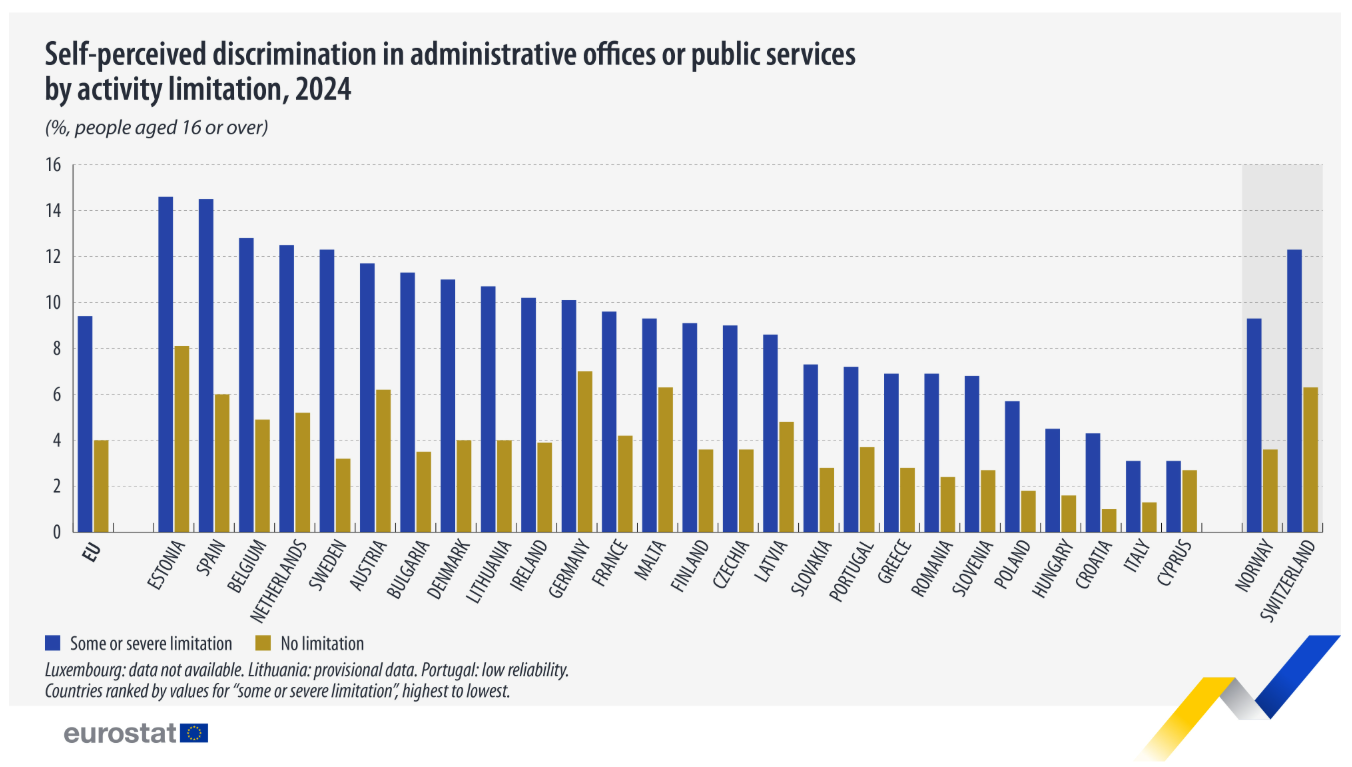
To coincide with ‘EU Diversity Month’, Eurostat has released new figures highlighting the discrimination experienced by people with disabilities across public administration, housing, public spaces and education. Based on self-reported experiences, the data reveals that people with disabilities are more than twice as likely to face discrimination in their interactions with public administrations than those without disabilities: 9.4% compared with 4.0%.
Among EU countries, Estonia (14.6%) and Spain (14.5%) recorded the highest levels of reported discrimination, while Italy and Cyprus reported the lowest rates, both at 3.1%.