
MEPs call for dedicated cancer funding in EU’s long-term budget
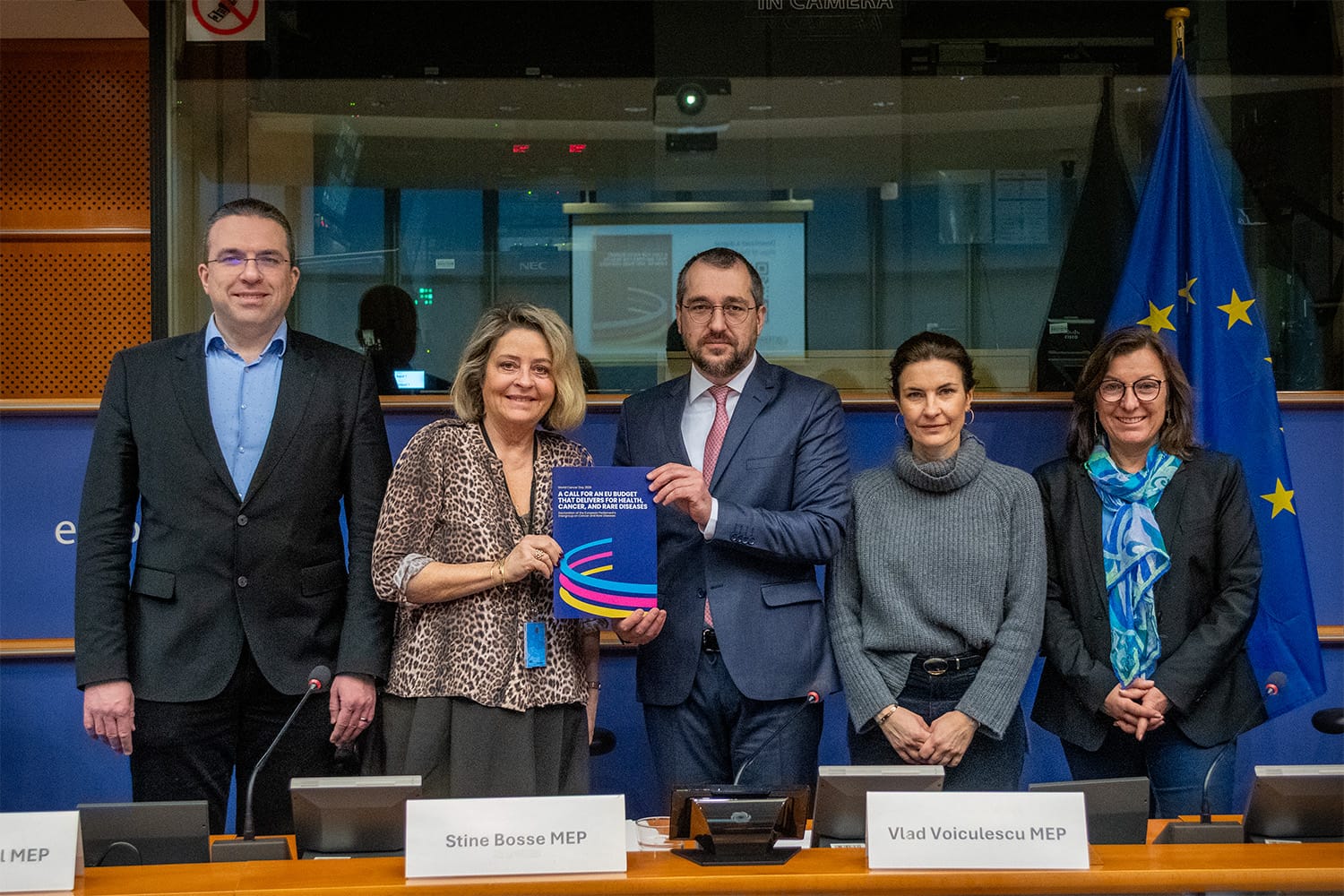
The European Cancer Organisation (ECO) has a clear message for the European Parliament: Europe’s Beating Cancer Plan is working and its future must now be secured. ECO warns that hard-won progress is at risk as negotiations begin on the EU’s next long-term budget for 2028–2034, with concerns that cancer could lose political visibility and financial support.
“This is a pivotal moment for European cancer care. We’ve come so far, are we really ready to retreat? Are we really ready to let so many innovative, lifesaving projects quietly fade away?” said ECO President Isabel Rubio.
On the eve of World Cancer Day, Members of the European Parliament from across the political spectrum issued a joint declaration calling for a strong, explicit commitment to cancer control and sustained funding in the next Multiannual Financial Framework.
“There is definitely consensus among MEPs in the cancer and rare diseases intergroup and more broadly in the public health committee,” Intergroup Co-Chair Vlad Voiculescu MEP told Vital Signs. “Anyone who has seriously looked at healthcare knows that every euro invested is a good investment. You can’t talk about strategic autonomy without tackling healthcare, including the production and availability of medicines.”
ECO has set out three core demands. First, it warns that placing health within a broader Competitiveness Fund alongside biotech and agriculture risks cancer funding being lost in a sea of competing demand. ECO is calling for a dedicated European Cancer Fund of €2 billion, within the fund, to deliver what it describes as the full promise of newly established EU cancer actions and cross-border cooperation.
Second, ECO is pushing for the creation of a European Cancer Institute to provide stronger coordination, accountability and long-term planning across research, innovation and policy. With the Horizon research budget expected to double under the next MFF, they argue that cancer must remain one of the EU’s flagship “moonshot” priorities.
Third, ECO highlights the potential of National and Regional Research Plans. With 14% of this funding currently earmarked for social objectives, ECO believes it could be used to support vaccination and screening programmes, workforce development, infrastructure investment and oncology data systems. ECO also supports increasing overall social spending from 14% to 20%.
“Health equity must be explicitly at the heart of Europe’s future,” said Alessandra Moretti MEP. “With strong EU funding focused on prevention, screening, care and access to treatment, we can reduce inequalities and ensure high-quality public healthcare for everyone.”
ECO is also interested in revenue-raising measures. Though it hasn’t managed to get the necessary support from finance ministers yet, ECO welcomes the proposed ‘Tobacco Excise Duty Own Resource’ (TEDOR) and would also be in favour of a similar approach to sugar-sweetened beverages.
Looking beyond the EU, ECO is calling on the European Commission to step up its global health leadership following the United States’ withdrawal from the World Health Organization. It argues that a future EU Global Health Initiative should help accelerate the elimination of cancers linked to HPV and hepatitis worldwide.