Inside EU Health: MFN; wastewater treatment; medical devices; social media
Implications of MFN note before summer; Várhelyi reassures ministers on Urban Wastewater Treatment implementation; on medical devices divisions persist over governance; special panel on online child safety will present its final report on 13 July
European Commission agrees to prepare a note on the implications of MFN before summer
The European Commission will prepare a note on the possible implications of Donald Trump’s “most favored nation” policy, under which prices of US medicines are capped at the lowest price charged by manufacturers in a basket of peer nations, including a number of EU countries.
Health ministers meeting today (16 June) in Luxembourg had meetings in the morning and over lunch to discuss the impact of MFN on the European medicines market. There is growing concern that companies are reluctant to launch treatments in Europe for fear of triggering the MFN.
Health Commissioner Olivér Várhelyi said after the Council that the Commission will be examining “which are the main products that might be affected by the MFN”, as well as whether the policy could affect “the launches of new products in the EU” or lead to “product withdrawals from [EU] markets”. The analysis will also look at wider effects on pricing, manufacturing and innovation. Várhelyi said the Commission would move quickly on the work, adding: “We want to be quick... I still want to do it before the summer.”
Várhelyi reassures ministers on Urban Wastewater Treatment implementation
Várhelyi sought to reassure health ministers about the implementation of the Urban Wastewater Treatment Directive amid growing concerns about its impact on medicine supply and production in Europe. He said that implementation must not lead to medicine shortages, product withdrawals or the relocation of production outside Europe.
Speaking at the press conference following the Health Council, Várhelyi said the Commission's position, set out in its Water Resilience Package, is that implementation "cannot lead to shortages or withdrawals of products from the market or to losing even more production to China and India."
Several countries called for a new impact assessment of the Directives provisions and some are seeking a pause in implementation. Várhelyi stopped short of making any promises for a further analysis or pause, but said the focus should be on carefully designing how the directive is implemented.
EU ministers back medical devices overhaul, but divisions persist over governance
EU health ministers broadly backed plans to overhaul the bloc’s medical devices and in vitro diagnostic medical devices rules at Tuesday’s Health Council, but divisions remain over governance, patient safety and the regulation of artificial intelligence.
Health Commissioner Olivér Várhelyi told ministers that Europe needs a “more proportionate, faster, and more effective regulatory framework” while maintaining patient safety.
There was broad support for simplification, but several delegations highlighted areas of disagreement. The Czech Minister Adam Vojtěch said he could not support the refurbishment of single-use medical devices and opposed giving authorities overseeing notified bodies a role in resolving disputes between manufacturers and certifiers.
Italian Health Minister Orazio Schilliaci said that he did not support solutions that would give the European Medicines Agency (EMA) a decision-making role in the classification of medical devices, arguing that they should retain a “non-binding advisory and technical support function”.
Ireland, which takes over the Council presidency next month, pledged to pursue an “ambitious target” of reaching a Council position swiftly, arguing that patients are “counting on us” to deliver a proportionate, risk-based system that supports innovation while safeguarding public health.
Irish Minister Carroll MacNeill said: “ We need to act swiftly now that the Commission has responded to the Council and indeed others' calls for reform.”
Special panel on online child safety will present final report on 13 July
The European Commission's Special Panel on Child Safety Online held its third and final meeting today. Co-chairs Dr Maria Melchior and Prof Dr Jörg M. Fegert will present a report containing their recommendations to President von der Leyen on 13 July.
The panel met as a new Eurobarometer survey revealed that adolescents spend an average of 4.5 hours online during school days and 6.1 hours at weekends, with 14% reporting more than 10 hours of daily screen use. Nearly one in three young people said social media makes them feel stressed, sad or socially excluded, while 45% admitted comparing themselves with others online.
The survey also found that around a quarter of adolescents have encountered harmful content, including hate speech, body-image pressure and violent material. Those who began using social media before the age of 10 reported significantly higher screen time than those who started after age 14.
European Commission President Ursula von der Leyen said the findings underscore the need for stronger action, noting that the impact of social media on young people's wellbeing "cannot be ignored".
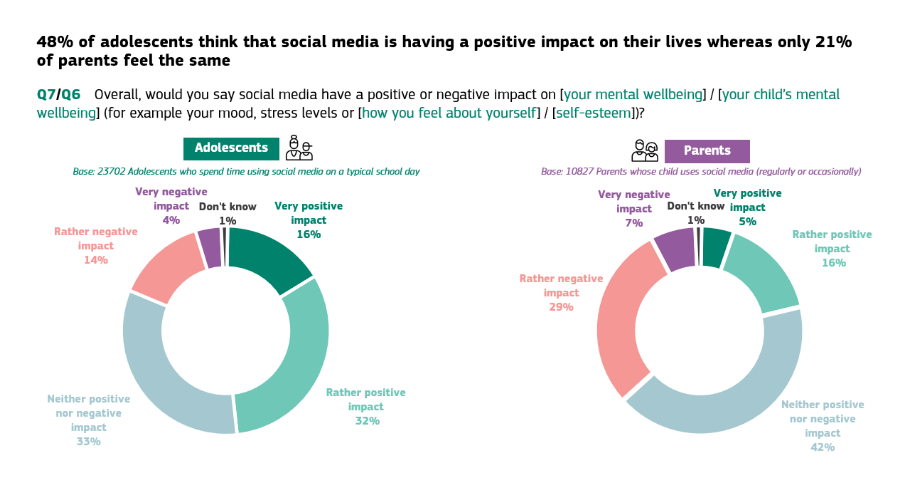
However, almost half (48%) of adolescents said social media has a positive impact on their mental wellbeing. Respondents cited entertainment as a key benefit (57%), while more than half use social media to stay in touch with friends and family (53%). Many also value its ability to foster a sense of connection with others (70%) and provide opportunities for learning and personal development (65%).