
Inside EU Health: European Centre of Clinical Excellence for Pharmaceuticals; Insta battle over ‘My Voice, My Choice’; Health Policy Leader Index
European Centre of Clinical Excellence for Pharmaceuticals; Instagram battle over ‘My Voice, My Choice’; Health Policy Index highlights ten MEPs; ECDC propose four new reference laboratories
Cypriots propose ‘European Centre of Clinical Excellence for Pharmaceuticals’
At tomorrow’s informal Health Council in Lefkosia, the Cypriot Presidency will propose the creation of a ‘European Centre of Clinical Excellence for Pharmaceuticals' (ECCE) intended to strengthen cooperation on clinical evaluation and the use of medicines across the European Union.
The proposed ECCE would be a “science-driven hub focused on clinical excellence”. The centre would not replace existing European or national bodies, nor interfere with member states’ competences in pricing and reimbursement.
So what would it do?
The centre would support the Health Technology Assessment processes, forming “non-binding, evidence-based pharmacotherapy recommendations and treatment pathways” that could be drawn upon voluntarily.
Rather than adding to the EU's alphabet soup, the Cypriots argue the ECCE could reduce duplication of work among national authorities and promote greater efficiency in the use of limited expertise and resources. The centre would also support training, knowledge exchange, and capacity building, with particular benefits for smaller or less-resourced national administrations.
Three possible organisational models are outlined for ministers’ consideration: establishing a new EU body through legislation; creating a flexible, EU co-funded Joint Action allowing gradual development; or embedding the ECCE within existing voluntary cooperation networks.
As a small aside, it should be noted that Cyprus is the only post-2004 EU member state which doesn’t host an EU agency.
Instagram battle over ‘My Voice, My Choice’
Ahead of tomorrow’s meeting of Commissioners and the official response to the My Voice, My Choice European Citizen’s Initiative (ECI). Activists have been piling on the pressure. In an Instagram post, Equality Commissioner Hadja Lahbib urged the group to “be patient, be confident”.
Activists responded via Insta: “We really wish we could be patient, but right now, as this very moment, there is a woman in a Polish Hospital dying because of a lack of abortion care. We really need safe abortion care now, not later.”
“We have a very clear message to you: anything less than what is in ‘My voice, My Choice’ ECI will be a betrayal of women across Europe. [...]. We will not be patient, and we really need you to deliver on what the millions of Europeans have voiced to you.”
More than 100 MEPs from the Greens/EFA, The Left, S&D and Renew wrote to the European Commission President today saying that the proposal does not seek to harmonise national abortion laws or interfere with member states' competences.
The MEPS support an EU-funded pathway that offers access to reproductive healthcare: “A refusal to act upon the initiative that has satisfied all Treaty conditions would raise serious questions regarding compliance with the principles of participatory democracy and sincere cooperation between institutions.”
 Catherine Feore
Health Policy Index highlights ten MEPs
Since 2024, RPP has ranked MEPs for their leadership in health policy. This year’s announcement of the ten leading MEPs in European health policy was also an opportunity to reflect on what leadership means in 2026.
RPP CEO Lutz Dommel said the EU must not get “trapped in linear thinking”: “We take today and extend it gently into tomorrow. But the world no longer develops that way. It moves in shocks, in ruptures, in geopolitical acceleration.”
Dommel argued that leadership in 2026 means recognising that “nothing is a given anymore.” Rather than remaining reactive, leaders must ask a more fundamental question: “What truly matters to us — as citizens, as researchers, as companies, as policymakers — before it is at risk? Leadership means protecting what matters before it is questioned.”
 Catherine Feore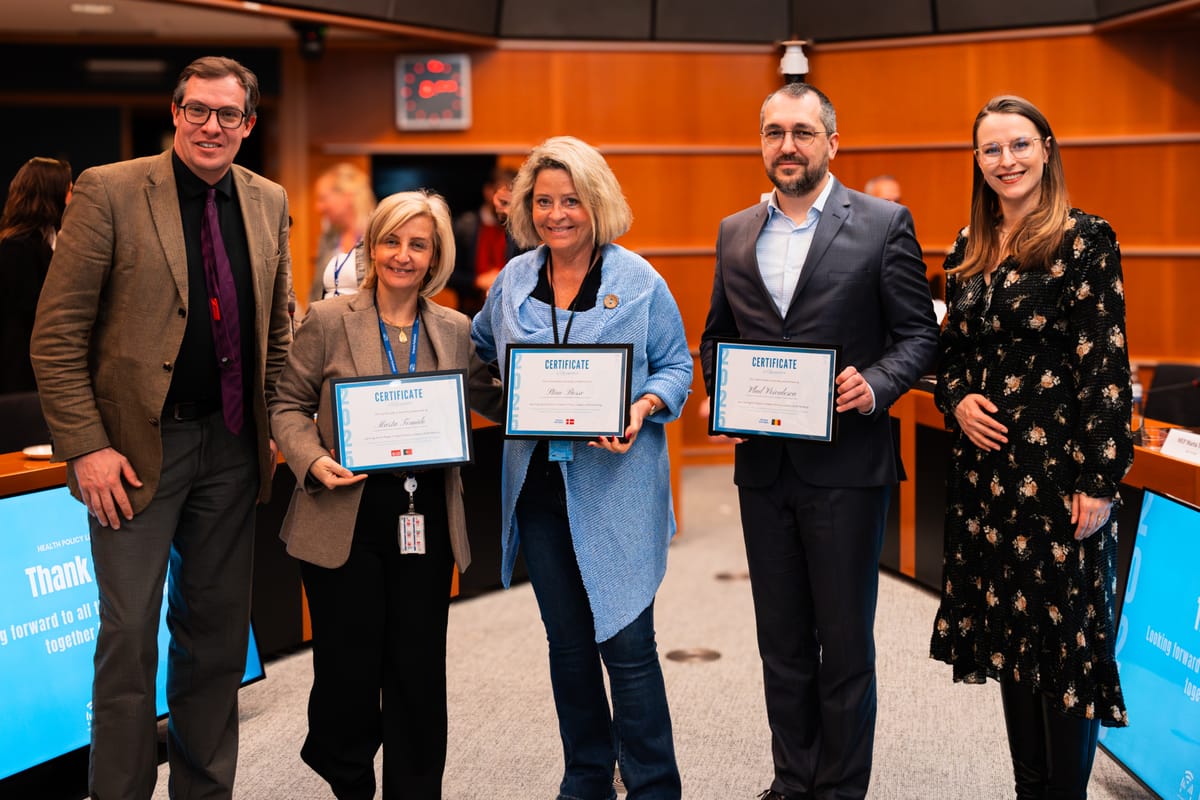
ECDC propose four new reference laboratories
The European Centre for Disease Prevention and Control (ECDC) is proposing the creation of four new EU Reference Laboratories (EURLs) to become operational in 2028: for Clostridioides difficile, drug-resistant gonorrhoea and other bacterial STIs, Mycobacteria (including tuberculosis), and invasive bacterial diseases such as meningitis.
EURLs are specialised centres that provide scientific expertise, harmonised diagnostics and comparable data to support EU-wide surveillance and response to infectious diseases. The ECDC argues that the new laboratories would strengthen outbreak detection, enhance antimicrobial resistance monitoring, and support faster, more accurate diagnostics across member states.
Looking ahead, ECDC identified future priorities that may require EU-level laboratory support, including fungal pathogens, biotoxins, arthropod vectors such as ticks and mosquitoes, and prion diseases. A 2026 stakeholder consultation will refine these priorities while improving the transparency and robustness of the EURL selection process.