
EU auditors urge clearer separation of health spending in €10.7bn crisis plan
EU auditors raise concerns over the Commission’s plans to expand the civil protection mechanism, warning that health funding needs clearer boundaries, stronger coordination and greater budgetary transparency.

The European Court of Auditors has delivered its opinion on the European Commission’s plans for two key proposals in the EU’s next long-term budget (MFF 2028–2034): the new Global Europe Regulation, which includes humanitarian aid, and a major overhaul of the Union Civil Protection Mechanism (UCPM), which would be expanded to include funding for health emergency preparedness and response (HEPR).
Under the Commission’s proposal, the UCPM would continue into the next budget period with a significantly larger budget of €10.7 billion, up from €3.6 billion currently allocated to the UCPM and around €1.7 billion earmarked for health crisis preparedness in the current period.
However, the Commission has not specified how the funding envelope would be split between civil protection and health emergencies, nor how resources would be allocated among prevention, preparedness, and response. The auditors warn that this lack of clarity risks undermining transparency and predictability. They argue that earmarking a minimum financial allocation for programmable prevention and preparedness activities would help balance flexibility and transparency.
MEPs have already raised concerns about the proposed repeal of the EU4Health programme and the creation of a European Competitiveness Fund, in which health would be grouped with biotechnology, agriculture and the bioeconomy. Parliamentarians fear this could crowd out health spending and have called for a ringfenced health programme. Under the Commission’s plans, EU4Health’s crisis preparedness activities would be incorporated into the UCPM and HEPR framework.
 Catherine Feore
While the auditors do not contest the need to strengthen the EU’s crisis response capacity, they question how the Commission arrived at the proposed budget. Although the Commission says it considered the current level of activities and capacities and the expanded scope of the mechanism, it did not provide a cost analysis explaining how the €10.7 billion estimate was calculated. In the auditors’ view, such information is necessary to support the proposed budgetary increase.
The auditors are also sceptical of claims that merging programmes will simplify the system. Although health emergency preparedness would be absorbed into the UCPM, the proposal contains no clear provisions on coordination between the civil protection and health components, a concern shared by MEPs.
 Catherine Feore
They further warn of potential overlap with other EU funding instruments, particularly for response activities, stressing the need to ensure complementarity and avoid double funding. This concern is heightened by existing EU legislation on serious cross-border threats to health. For example, the UCPM proposal would extend reporting cycles from three to five years, while the regulation on cross-border health threats operates on a three-year reporting cycle.
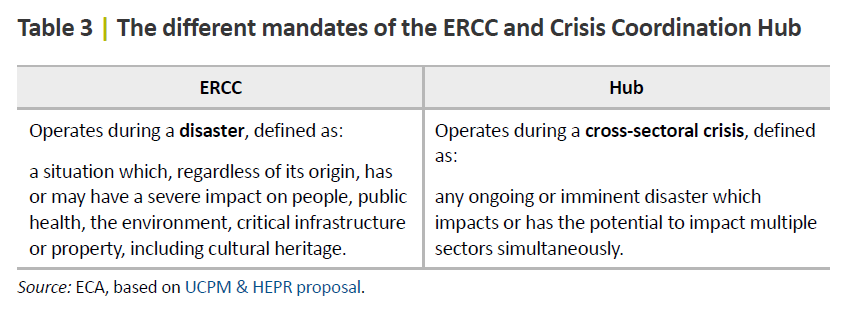
The creation of a new EU crisis coordination hub also raises questions. The Commission insists that this would not replace the existing European Response Co-ordination Centre, with the two structures operating in parallel. However, the auditors say the legislative text is not clear enough to reflect the Commission’s intentions, warning that in crisis situations clear provisions on coordination and responsibility among stakeholders are essential.
Finally, the auditors flag accountability risks linked to the expanded use of financing not tied to costs, cautioning that this could increase compliance risks unless safeguards are strengthened. They also call for their audit rights to be explicitly set out in the new regulation.